
Ask any sales manager to open their CRM and tell you what happened on their team’s last ten calls.
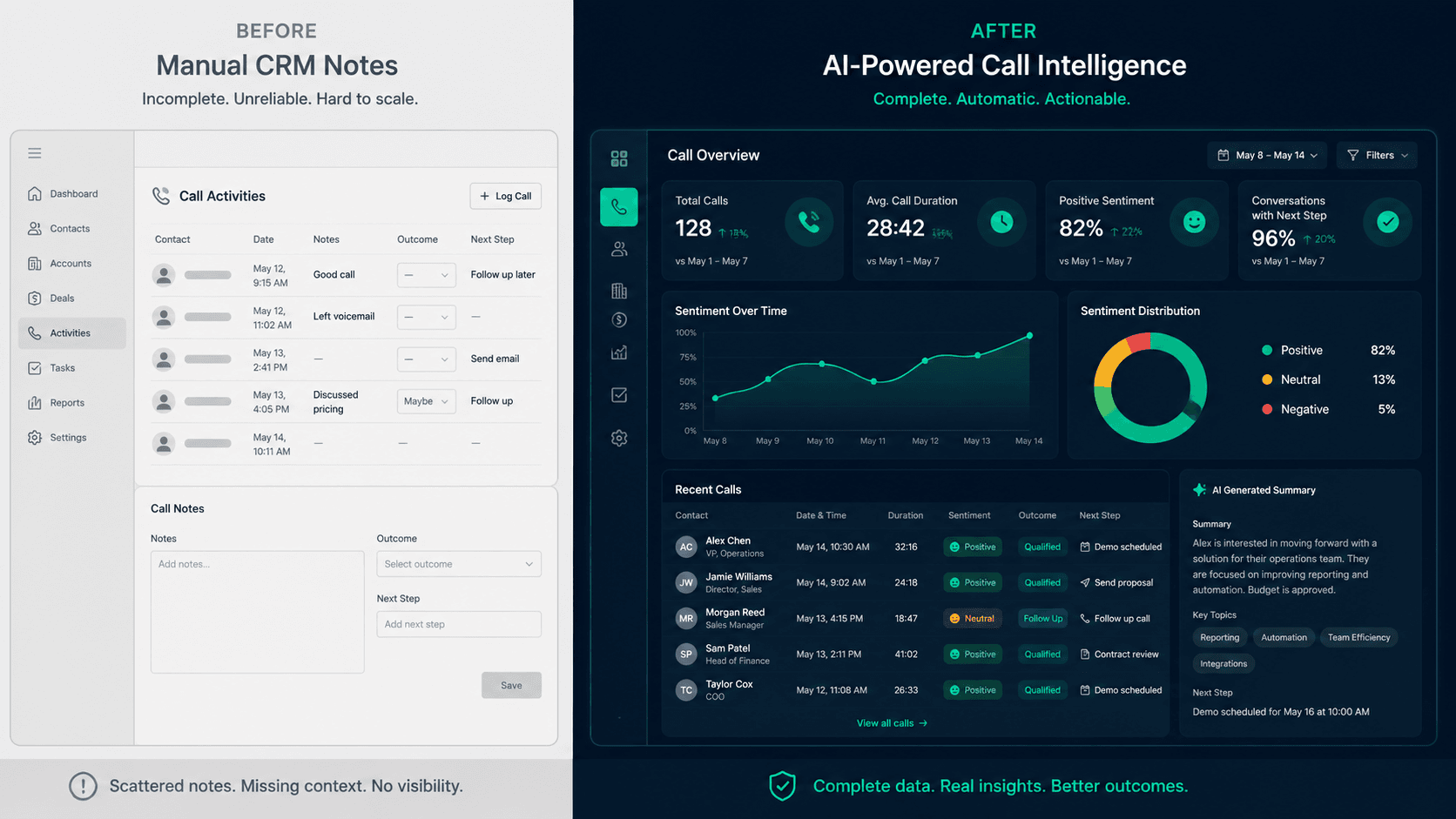
What they will find: three entries that say ‘Left voicemail.’ Two that say ‘Good call – following up.’ One was written four days after the actual conversation. And four that are blank, because the rep meant to fill them in later and never did.
This is not a discipline problem. It is a structural one. CRM notes were designed for a world where writing down what happened on a call was the best tool available. That world no longer exists.
“Your CRM holds what your reps remembered to type. Your calls hold what actually happened.”
The real cost of incomplete CRM data
The consequences of CRM notes as the primary record of sales activity show up in four painful ways:
1. Deals stall when context disappears
A rep is reassigned. A manager reviews a deal. A new sales engineer needs to prepare for a technical call. They open the CRM and find: ‘Interested – needs legal review.’ That is the entire record of a six-week sales cycle with eight touchpoints.
Nobody knows what was discussed in the demo. Nobody knows what objections came up. Nobody knows whether legal was the real concern or a deflection. The deal has to start from near-zero – or the rep makes it up and risks the wrong conversation.
2. Forecasting is based on opinion, not evidence
When a manager asks a rep to forecast a deal, the rep’s answer is based on their gut feeling from the last call – not structured data from all the calls. ‘They seemed interested’ is not a forecast. It is a guess informed by memory.
| Research consistently shows that CRM data entered manually by sales reps has an accuracy rate below 50% – not because reps are dishonest, but because memory degrades, notes get abbreviated, and ‘I will fill that in later’ rarely happens. |
3. Coaching becomes reactive instead of systematic
A manager who relies on CRM notes to understand how their reps are performing will always be behind. They will find out about the struggling rep when a deal falls apart – not two calls earlier when the warning signs first appeared.
Systematic coaching requires systematic data. And CRM notes – however disciplined your team is – are not systematic. They are qualitative, subjective, and incomplete by nature.
4. At-risk deals are invisible until it is too late
A prospect mentioned a competitor on call three. The rep noted it as ‘competitive – monitoring.’ By call five, the sentiment had shifted noticeably. The rep noted it as ‘good call, progressing well.’ The deal was lost on call six.
The signals were there. They just were not in a format anyone could act on in time.
What modern sales visibility actually requires
Sales visibility in 2026 means knowing – in real time and at scale – what is being discussed on your team’s calls, how prospects are responding, what commitments were made, and where deals are genuinely heading versus where reps believe they are heading.
This requires three things that CRM notes cannot provide:
- Structured, consistent data from every call – not just the ones a rep remembered to document
- Sentiment and behavioural signals that a rep cannot objectively record about their own conversations
- Automatic synchronisation so data exists in the CRM immediately, not when admin time allows
None of these require replacing your CRM. They require giving your CRM better data to work with.
The shift: from manual notes to conversation intelligence
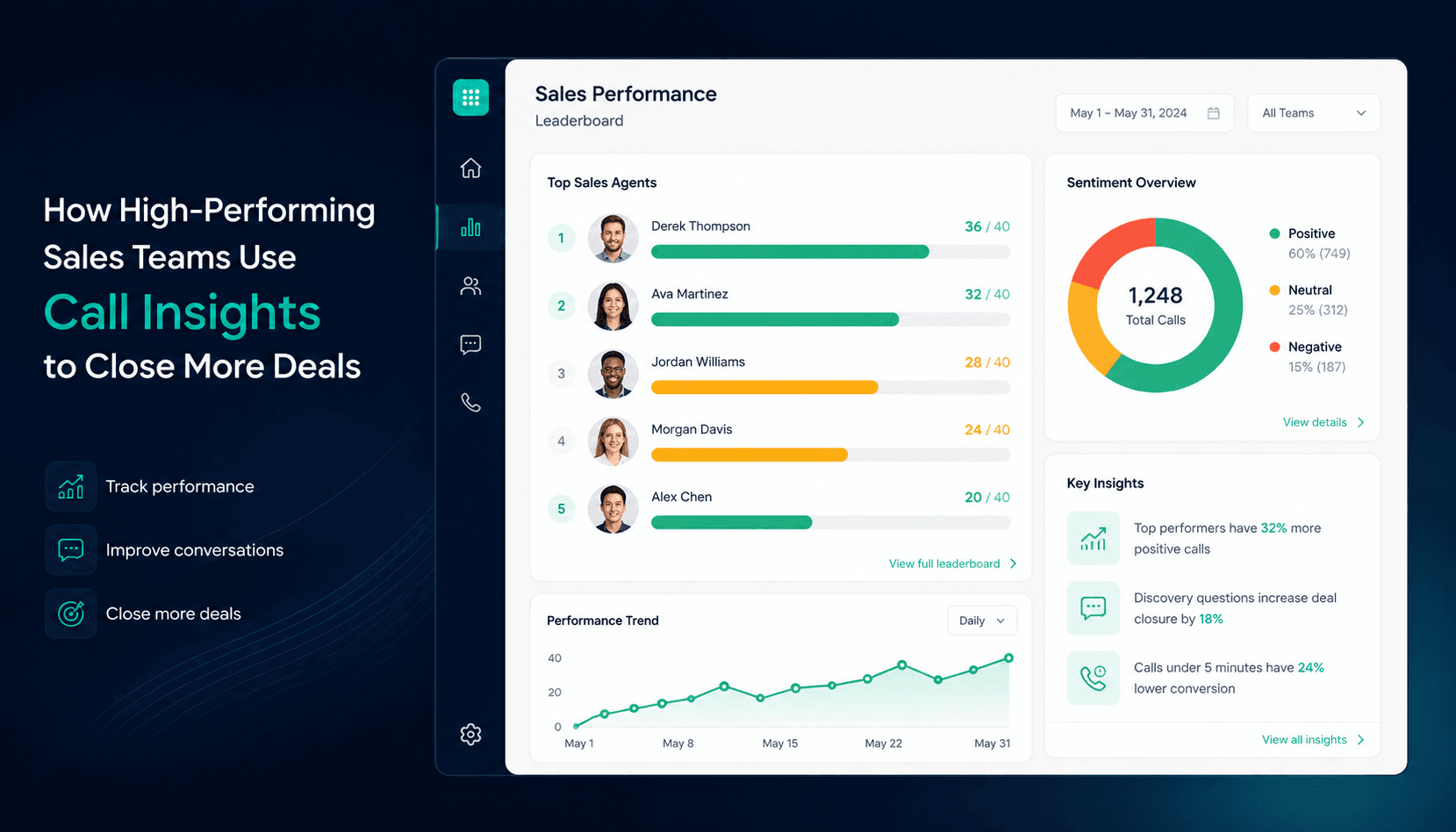
Conversation intelligence tools record and analyse sales calls automatically – pulling out the information that matters and pushing it into your CRM without rep involvement.
What this looks like in practice:
- Every call is transcribed in real time with speaker labels – no manual notes required
- An AI-generated summary lands in the CRM immediately after the call ends
- Action items are extracted and logged automatically – both rep and prospect commitments
- Sentiment score and call quality score are recorded for every interaction
- Managers get structured, comparable data across every rep – not narrative notes that vary wildly
The result is a CRM that reflects reality – not a filtered, time-delayed, rep-authored version of it.
What changes when your CRM data is actually complete
When a manager can see what was discussed on every call – not just what was noted – three things change meaningfully.
Forecasting becomes grounded in evidence. A deal marked as ‘80% likely to close’ can be tested against the call data – is sentiment trending up or down? Was a next step confirmed on the last call? Was pricing addressed or avoided? These questions now have answers.
Coaching becomes proactive. The manager does not need to ask ‘how is that deal going?’ They can see how it is going – and flag a coaching conversation before a deal is lost, not after.
Handoffs become seamless. A new rep inheriting a deal reads the conversation history – real summaries from real calls – and walks into the next meeting prepared. The prospect never has to repeat themselves.
“CRM notes tell you what your rep thought happened. Call intelligence tells you what actually did.”
The bottom line
CRM notes are not going away. They still have a place for qualitative context that no AI can capture – the rep’s read on a relationship, a flag about stakeholder dynamics, a personal detail worth remembering.
But as the primary source of sales visibility? They have never been enough – and in a market where your competitors are operating with full call intelligence, they are now a genuine competitive disadvantage.
The teams winning deals in 2026 are not the ones with the most disciplined note-takers. They are the ones who stopped relying on notes entirely.
Stop relying on what your reps remember to type.
CallVibe syncs full call intelligence to your CRM automatically. Try it free for 14 days at callvibe.ai.